Cross-Domain Intelligence, Empowering Microrobots

Integrating physical, biological, computational, and human intelligence to achieve multifunctional, collaborative, and adaptive microrobots, opening new frontiers in precision medicine.

Explore the Four Intelligence Domains

Review Overview

This website is based on the paper "Embodied Cross‑Domain Intelligence in Biomedical Microrobots: A Review", extracting and presenting its logical framework and core findings. It serves as a dynamic resource that continuously tracks and updates the latest research achievements in the field of micro/nanorobotics over the past three years.

The paper proposes the "embodied cross‑domain intelligence" framework, emphasizing the synergistic integration of four intelligence domains—Physical (PI), Biological (BI), Computational (CI), and Human (HI)—to address tasks in complex biomedical environments.
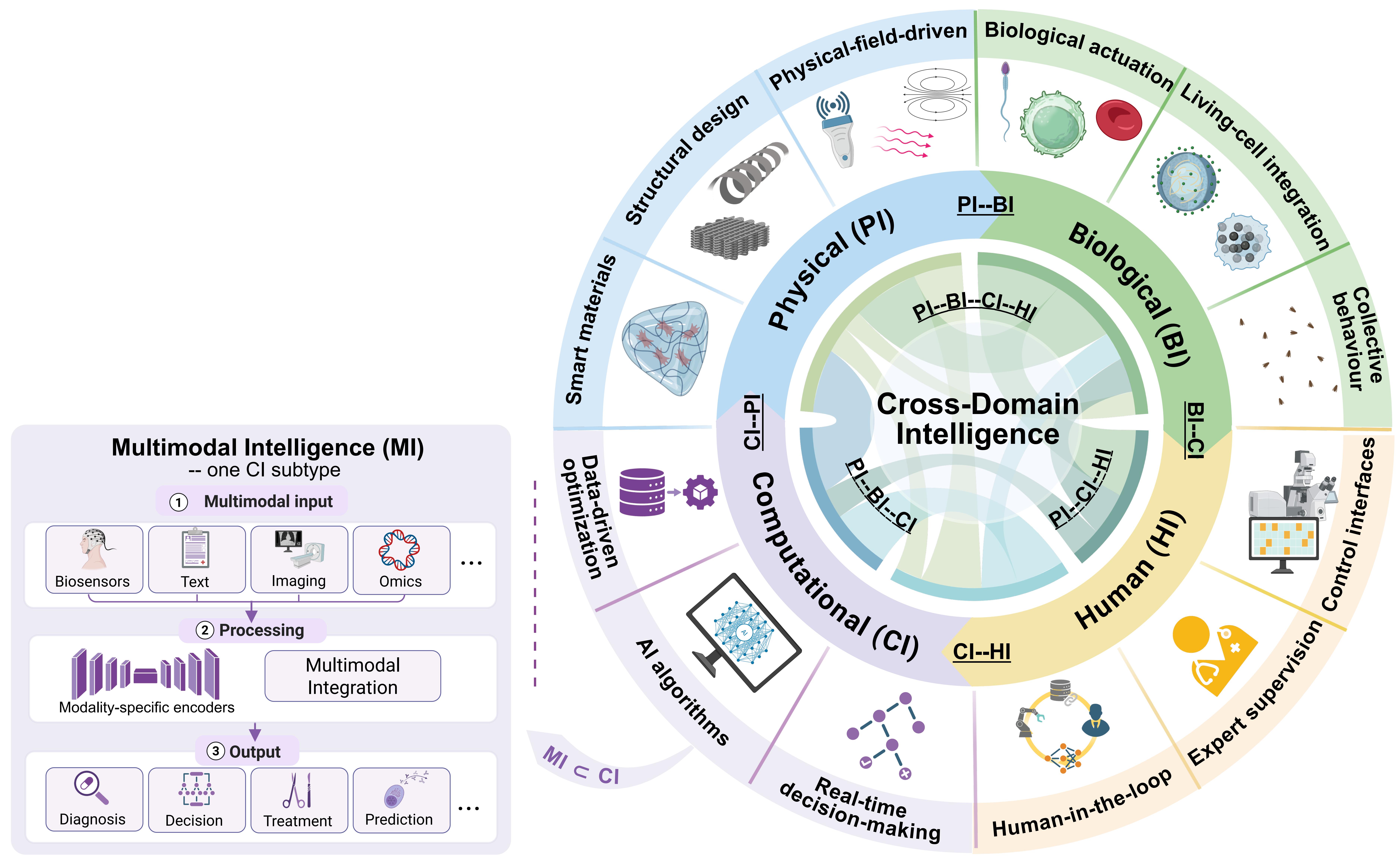
Cross-Domain Intelligence Diagram
PI icon
Physical Intelligence (PI)

Embedding sensing and actuation capabilities directly into the robot body through material and structural design to achieve adaptive functions.

BI icon
Biological Intelligence (BI)

Integrating cells or microorganisms as actuation and sensing units, endowing robots with biological capabilities such as chemotaxis and self-healing.

CI icon
Computational Intelligence (CI)

Based on perception, learning, and control algorithms to achieve autonomous navigation, decision-making, and optimization.

HI icon
Human Intelligence (HI)

Leveraging expert knowledge, remote manipulation, and shared control mechanisms to provide safety assurance and clinical decision-making for high-risk tasks.

Last updated: 2026-01-15. We regularly search for the latest research findings and update the content.